Blog
Critical Thinking as a 21st-Century Skill
People used to finish school and work the same job for the rest of their lives. That era is over. We live in an information society, one that keeps changing what any individual needs to know how to do. That constant flux is one of the main arguments for redefining what education is even for. In recent years, education circles have increasingly leaned on the term 21st Century Skills.
“A school in the twenty-first century can’t primarily prepare students for specific jobs, since by the time they reach adulthood those jobs will either be radically different or won’t exist at all.” — Černý, 2017
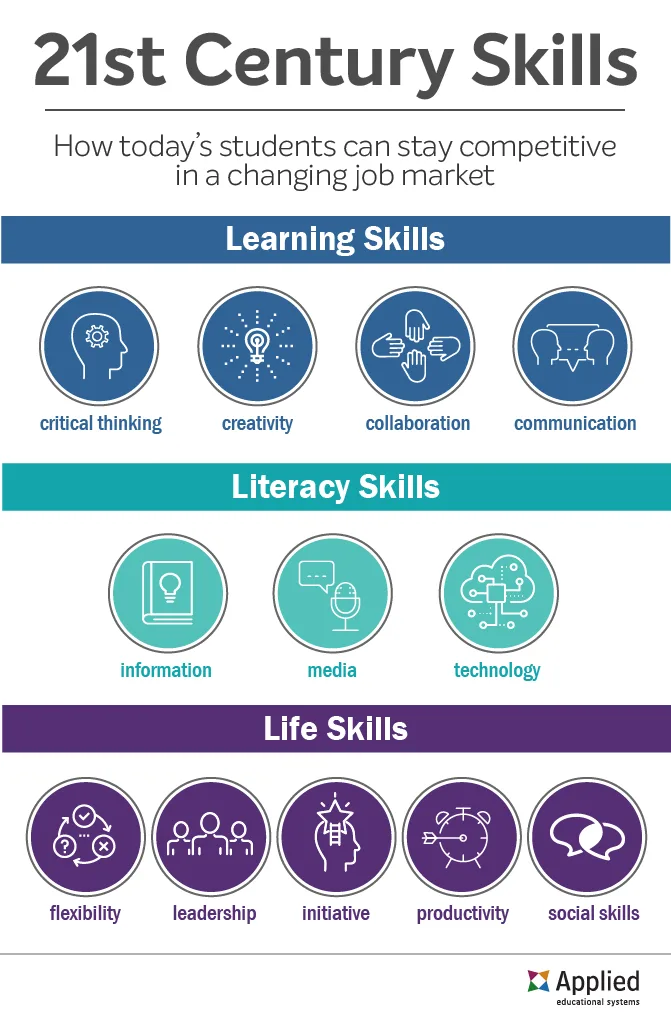
Different authors and studies frame their skill lists differently, but the same specific competencies tend to come up again and again. One of the most frequently mentioned is critical thinking. Applied Education Systems groups it together with creativity, communication, and collaboration under learning competencies — skills that are essential for an information society, and by extension, a learning one.
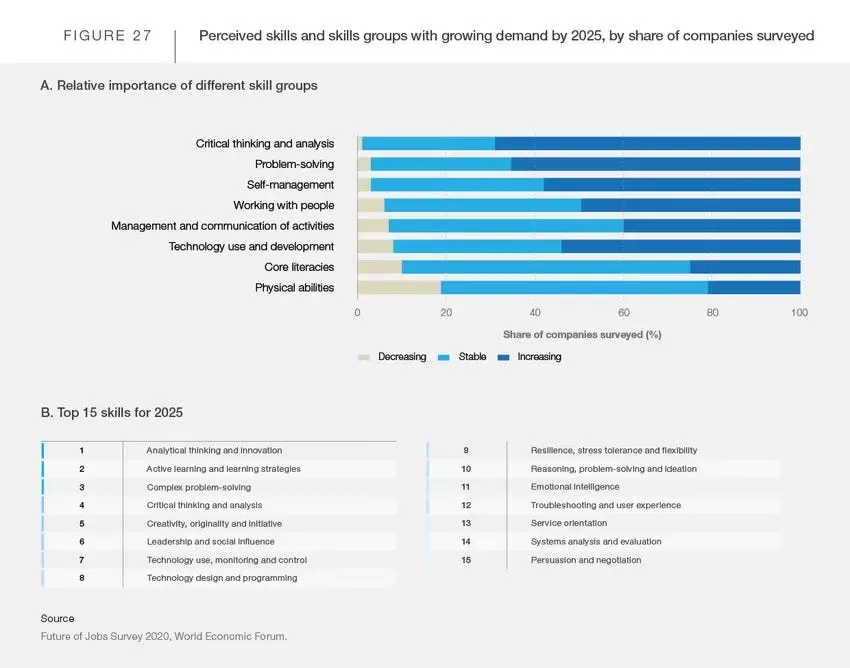
According to the World Economic Forum, half of all employees will need to retrain, or pick up new skills, by 2025. Critical thinking, alongside problem-solving, sits at the top of the list of skills employers say they’ll need. And let’s stay with the economics angle for a moment longer. McKinsey & Company surveyed recruiters and found that critical thinking, alongside problem-solving and an innovative mindset, was among the abilities HR specialists most often find lacking in job candidates — while also considering it one of the most needed, especially in a world that’s steadily automating.
Harvard professor Tony Wagner, in his book, lays out 7 core competencies (article in Czech) that today’s children will need to survive in 21st-century society — and he, too, puts critical thinking first. But it’s no longer just economists and academics talking about critical thinking. The topic has spread to the general public as well, and the term is often overused or applied very vaguely (article in Czech).
So what actually is critical thinking? According to Wikiknihovna (a Czech library-science wiki), it’s “independent thinking that treats information as a starting point, seeks out reasonable arguments, begins with questions and problems, and is at the same time a form of social thinking.” According to the Stanford Encyclopedia of Philosophy, it’s a broad concept that can, at best, be generalised as “careful goal-directed thinking,” though the encyclopedia devotes an entire chapter to the term’s history and conceptualisation. Psychology professor Jaro Křivohlavý (a Czech psychologist) emphasises, above all, a willingness to “seek out arguments that speak against what a person considers 'certain' — against their own understanding and cherished (beloved) beliefs, against their own goals and plans.”
In the Czech educational environment, critical thinking is associated mainly (aside from business ventures, the best-known of which is probably Krimyš, a Czech critical-thinking consultancy) with continuing education for teachers — particularly through the accredited programme Reading and Writing for Critical Thinking (article in Czech). Freely available critical-thinking lessons for the general public are actually easier to find abroad — on TedEd, for instance.
It’s worth remembering, though, that watching a few lessons or reading some how-to guides on critical thinking isn’t enough on its own. The principles of critical thinking need to be not just known, but actually applied.
Further sources
Illustration for this article by Jesse Martini on Unsplash
ČERNÝ, Michal. Informační a učící se společnost (The information and learning society). (in Czech)
NEUMAJER, Ondřej. Inovativní výukové aktivity pro rozvoj dovedností pro 21. století (Innovative teaching activities for developing 21st-century skills). (in Czech)
KŘIVOHLAVÝ, Jaro. Psychologie moudrosti a dobrého života (The psychology of wisdom and the good life). (in Czech)