Blog
Digital Wellbeing

There’s no doubt that technology is useful in many ways. It drives social progress and can speed up, simplify, and streamline countless activities. Even in the current pandemic era, its usefulness is undeniable. But we can’t look at technology as a saviour alone — the topic deserves more than a one-sided view.
The pandemic shut a billion people indoors around the world. Covid-19 shook not just healthcare, but society, the economy, and politics. A year and a half after the pandemic began, we’re no longer just seeing the primary impact in case and death statistics — we’re seeing plenty of secondary effects too. [1] During the pandemic, 4 in 10 American adults reported feelings of anxiety, and among young adults (18–24) symptoms of anxiety or depression appeared in as many as 56% of those surveyed. [2] A third of the US population also reported worsened sleep problems in July of last year. [3]
In the Czech Republic, the pandemic pushed one in ten Czechs into depression. Young adults are one of the most at-risk groups here too. [4] According to the National Institute of Mental Health (a Czech research body), a third of Czechs are dealing with some form of mental illness as a result of the Covid-19 pandemic. Compared to the pre-pandemic period, the incidence of depression and suicide risk tripled, and anxiety disorders doubled. [5] Taking care of your mental hygiene matters more today than ever.

Stock photo by Annie Spratt on Unsplash
Technology and mental health
In the context of this article, it’s worth noting that technology itself isn’t the main culprit, as the introduction might suggest. Negative emotional states and declining mental health and wellbeing are, above all, a reaction to restrictions, uncertainty, and social isolation, or an expression of fear for ourselves or the people close to us. Mental hygiene is a broad toolkit that helps us maintain psychological health. Its foundation is a solid lifestyle — a balanced diet, enough exercise, or quality sleep. [6] But our relationship with technology plays a substantial role here too.
Let’s pause for a moment on sleep, since its quality feeds directly into our overall mental wellbeing. [7] Excessive exposure to technology has a negative effect on sleep: it’s not just harder to fall asleep (partly because of so-called blue light, which suppresses the production of melatonin — the hormone that helps us fall asleep), our sleep is also lower quality, since blue light and information overload affect our REM and NREM sleep phases. We end up not using our full sleep potential. [8]
Technology affects our mental wellbeing in more than one way. Because of lockdowns, most meetings, consultations, and school lessons moved online. There, we find ourselves alongside many other people we’re forced to interact with. At a time when we shouldn’t be seeing anyone in person, that’s genuinely useful. But this phenomenon also brings negative effects in the form of fatigue or burnout from overusing communication tools — a phenomenon a Stanford study gave the collective name Zoom fatigue. [9]
Stock photo by Elena Mozhvilo on Unsplash
Many people now working or studying from home may also be at greater risk of so-called technostress — being unable to find a “healthy relationship” with new technologies. [10] The line between free time and work blurs, which often leads to workaholism and spending excessive time with digital technology. That state can escalate into so-called technology overload. [11] Not far from this concept are information overload and cognitive overload (article in Czech). And there are plenty of other negative effects on the psyche. On top of that, the developers of some digital apps are often chasing profit above all, so the technology ends up designed in ways that actively work against our wellbeing. [12]
In recent years, the risks of social media (article in Czech) for children and teenagers have come up a lot — things like cyberbullying, cybergrooming, and problematic/addictive internet use. Digital technology is often the trigger or the medium for various socially pathological phenomena. [13] And all of that can feed into our mental wellbeing. The phenomenon of social comparison (article in Czech) also has a major effect on mental wellbeing. And the list goes well beyond that.
These harmful effects existed long before covid. But the issue is more serious now, precisely because so many people — often involuntarily — are coming into contact with digital technology far more intensively than they were used to before the pandemic. Teaching has largely moved (or had moved) to distance learning, many employees shifted to working from home, and public life migrated from concert halls, foyers, and theatres to streaming platforms. As the number of things happening online grew, so, naturally, did the time spent in that environment.
According to data from the National Library of the Czech Republic, the biggest growth was in “watching films and series (+24%), reading text online (+23%), using social media (+19%), and following the news (+19%). (…) The coronavirus pandemic showed up most strongly in the media behaviour of the youngest generation (15–24), where most media activities grew far more than in other generations.” [14]
More time spent on technology doesn’t necessarily increase its negative impact, though, and doesn’t necessarily reduce our wellbeing on its own. According to a recent Oxford study, the link between worse negative feelings and more time spent with media is a correlation, not causation. It may well be true that spending more time with media causes negative feelings — but it could just as easily be the other way round, with people fleeing to media for longer periods because of their negative feelings in the first place. [15] Either way, media and digital technology have become a place where we spend a great deal of our time — and that alone is reason enough to think about how we’re using that time and how we feel while we do it.
The scientific community is also showing growing interest in the topic of technology use and its effects; the number of studies and articles on our relationship with technology has grown substantially in recent times. [16] The need to reflect on our relationship with technology for the sake of our mental wellbeing is also underlined by recommendations from the Association of Clinical Psychologists of the Czech Republic. In one of their infographics on better psychological wellbeing, for instance, they recommend a “media fast”. [17]
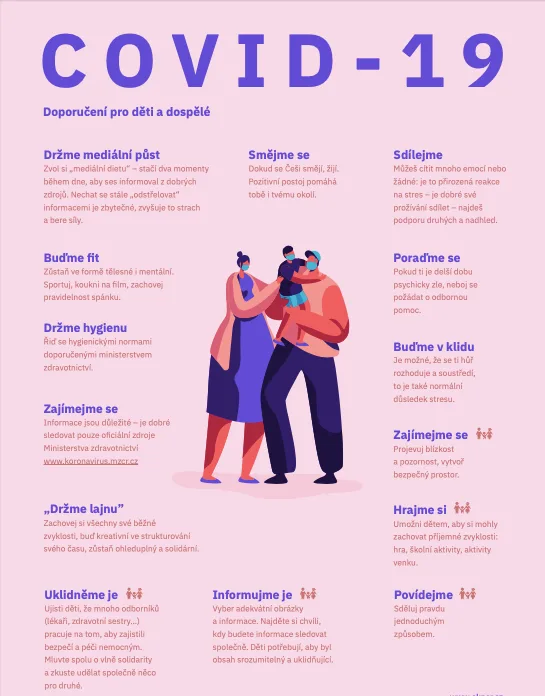
Infographic by the Association of Clinical Psychologists of the Czech Republic
Should we just get rid of technology?
Even though technology faces plenty of criticism, it’s worth remembering its usefulness too. We live in an information society, and technology is an essential part of it. And even now, we see its upsides — with only minor breaks, tens of millions of students around the world have been reliant on learning from home for more than a year. [18] Thanks to technology, (not everyone, of course, but at least some) students have access to education at all.
And education isn’t only accessible online to students in formal education. All of us can now learn something new virtually, any time. And it’s not just about education itself. Social media, for instance, can also help us with a feeling of complete isolation. It can also serve as a source of endless inspiration, and we can use it to build our own digital identity. [19] And when used the right way, it can actually be good for our wellbeing. [12]
In his bestseller Deep Work, American academic and author Cal Newport advises people to accept the fact that social media and other technologies aren’t inherently evil, and can be important to us in plenty of ways. At the same time, though, we need to set criteria that a given service must meet before we give it our time, attention, and personal data. [20] Removing all digital technology from our lives entirely probably wouldn’t be wise. The solution lies more in finding a middle ground. Newport develops this further in another one of his successful books — Digital Minimalism. It’s not about cutting technology out of your life completely, and it’s not “digital hermitage.” It’s exactly that middle path between technological maximalism and a total absence of technology. [21]
“Digital Minimalism — A philosophy of technology use in which you focus your online time on a small number of carefully selected and optimized activities that strongly support things you value, and then happily miss out on everything else.” — Cal Newport, 2019
The foundation of digital minimalism is intentionality rather than mindless technology use. Whenever a new technology appears (say, a new social network, or a new type of product), a digital minimalist asks themselves whether they truly need it. They reflect on their values and consider whether the new thing can serve those values and goals in the best possible way. If the answer is no, the minimalist either doesn’t bother with the technology at all, or tries to optimize it so that it genuinely serves their vision as much as possible — say, by installing the app but turning off its notifications. [21]
A digital maximalist, on the other hand, (who naturally lurks inside most of us) only needs to sense that using something new might bring any potential benefit — and that’s reason enough to start using it. [20] Unlike the minimalist, they don’t factor potential harm into a “cost-benefit” analysis — in fact, they probably never run that analysis at all.
Digital minimalism is really about reflecting on what technology can give us, and what it can take from us. It’s about intentionality and consciously deciding to cut out of your tech life the things that aren’t important to you but that you still do — often unintentionally, automatically, say as a form of procrastination. Digital minimalism is about finding your own balance. [21]
So how do you find that balance?
The internet is full of advice on shrinking technology’s share of our lives, or bringing minimalism into it. I picked out a few of those tips [20] [21] [22] [23] [24] [25], added some observations of my own, and sorted everything into a few categories:
1) Keep track of your own behaviour:
- Track your screen time and get a clear picture of what takes up the most of it.
- Find out which apps eat up more time than you’d like.
- Notice what emotions different kinds of content trigger in you.
- Describe how you feel when you can’t be online for a while.
- Identify the things you do automatically, without thinking about them.
- Consider whether you might be addicted to technology — you can even take a test (in Czech).
2) Get rid of your enemies:
- Adjust your notifications, or turn them off entirely.
- Delete apps you spend needlessly too much time in.
- Clear out files, apps, games, and photos you don’t need.
- Block a few (useless, time-wasting) websites.
- Unsubscribe from newsletters you don’t need.
- Stop following social media profiles that give you nothing.
- Tidy up the files on your computer and try to keep some kind of order in them from now on.
3) Consciously restrict yourself:
- Switch your phone/tablet/other temptation to greyscale, so it’s less appealing to look at.
- Set “office hours” for when you’re allowed to use technology.
- Only check the news once or twice a day.
- Only open email (or another app of your choice) once or twice a day/week.
- Make apps harder to reach — put them in nested folders so they’re not one tap away.
- Or, at the very least, set a time limit on them.
- Keep your computer desktop or phone home screen as empty as possible.
4) Try going without them for a while
- Try a digital detox — disconnect for a set time, tell the people around you in advance, set up an out-of-office reply. And just switch off.
- Put your phone far away from you while you work — another room, even.
- Don’t bring your phone to meetings, the pub, or birthday parties.
- Try going for a walk without your phone and just look around you.
- Don’t sleep with your phone in the room — you could even ban all digital technology from your bedroom entirely.
5) Find an alternative
- Write notes by hand on paper, get yourself a nice notebook you’ll enjoy using.
- Get a paper planner and use it instead of a digital one.
- Go for more walks in nature, get some exercise.
- When the situation allows, meet a friend in person instead of calling.
- Make use of so-called creative solitude.
- Spend time alone with yourself and your own thoughts.
- Make something with your hands — craft, sew, draw, colour, plant flowers.
- Meditate, practise mindfulness.
Even this mash-up of internet advice isn’t a cure-all, though. Each of us has to figure out our own approach to technology, based on our own needs. You can’t tell a working journalist to switch off their phone during work or leave it in another room. Or tell a graphic designer to ban colour from their screen. And we probably wouldn’t want our thesis supervisor to only check their inbox once a week.
Different guides can serve as good inspiration. If we want to be digital minimalists, or simply want to feel good in a digital environment, we have to think through our own rules. It’s a good idea to set time blocks or “office hours” — but according to your own needs. It doesn’t matter whether that’s 20 minutes a day on Twitter, checking email four times a day, or not watching the news before 2pm. What matters is setting some kind of time or duration. And prescribing yourself other rules the same way. Maybe a daily hour-long walk without your phone, or swapping Sunday internet scrolling for a board game with your family. The main thing is to sit down undisturbed, actually think it through, decide, and set it — pick and combine the approaches and methods that will personally help you feel content.
Feeling good = being competent
Digital wellbeing isn’t the same thing as digital minimalism. It’s not just about the amount of time and number of apps we use. It’s not just about the intentionality mentioned above. It’s a broader concept, one that belongs among digital competencies. In the European DigiComp 2.0 framework, wellbeing sits under the Safety component. Protecting physical and mental health and wellbeing appears within digital competencies right alongside protecting your devices, personal data, and environment. [26]
“Digital wellbeing — The conscious use of technology to enable each individual to realise their potential, to benefit them and their community” — Georgie Powell, 2019
According to journalist and digital-wellbeing expert Georgie Powell, digital wellbeing is about how well we’re able to use technology for good purposes. Her concept of digital wellbeing covers six areas:
- Control — When, where, and why a device is being used.
- Access — Easy availability of the services people need.
- Citizenship — Exposure to social and antisocial online behaviour.
- Composure — The pretence that masks the emotions triggered by online activity.
- Identity — Managing your data, privacy, and digital identity.
- Information — Open, unpolarised access to information. [27]
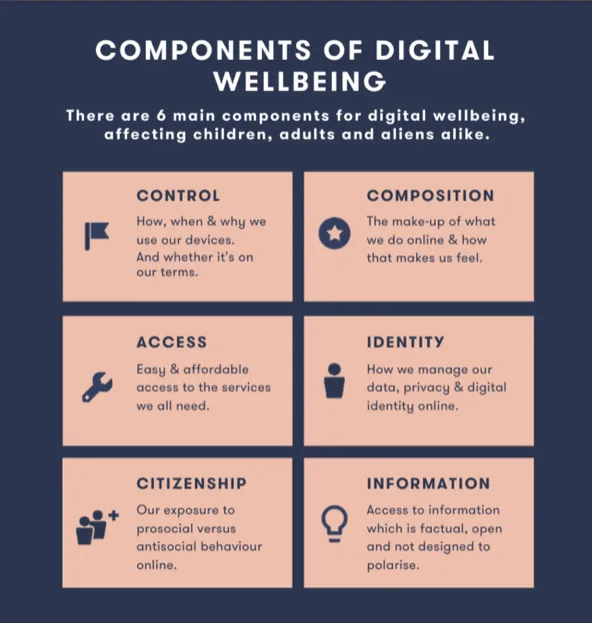
Part of an infographic by Georgie Powell
There are, of course, plenty of similar concepts, models, and framings. What matters about them is that they don’t limit themselves to a purely quantitative view, and don’t treat “get away from technology” as the main solution. Instead, they bring in further context and look at what we’re actually doing with technology, and what we’re using it for.
You’ll also find digital wellbeing conceptualised in the Czech context, where it’s currently a focus of the Partnerství 2030 project (a Czech education-sector initiative supporting the government’s Strategy 2030+ plan). The authors of the concept see digital wellbeing as a set of distinct competencies:
- Digital literacy — at a level that gives someone confidence in their own abilities, and lets them use those abilities to solve the problems they run into. Digital minimalism — knowing when to use digital technology and when not to — falls under this competency too.
- Safety — protecting your devices and personal data, but above all, being able to handle the real risky situations you might encounter in digital space.
- Health — physical as well as mental, including things like correct posture at a computer or protecting your eyesight from excessive screen exposure.
- Information and media literacy — working with trustworthy information, critical thinking (but not apathetic scepticism!), and the ability to build your own (verified, trustworthy) personal learning environment.
- Collaboration and sharing — digital communication, connecting effectively with others, a personal learning environment built through interaction with other people.
- Digital citizenship — debunking disinformation, discussion in the public space, defending democratic values, taking an active approach to information and your digital footprint.
- Creativity — creative thinking, a constructivist approach, inquiry-based learning, project work.
- Achieving personal goals — the peak of the potential wellbeing pyramid: the art of setting your own goals and reaching them, using technology to help. [28]
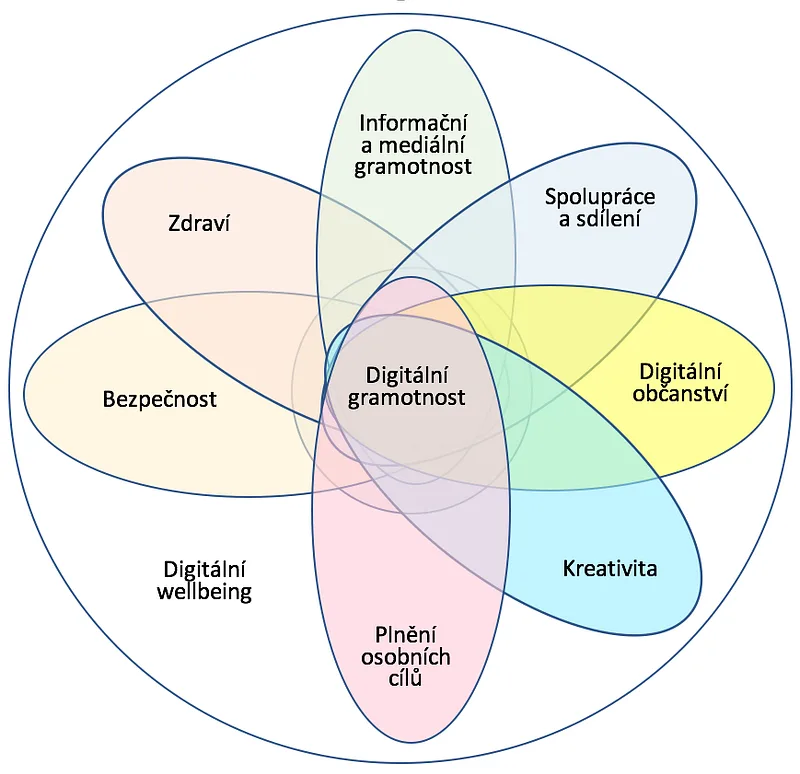
Diagram of the digital wellbeing competency framework from the Partnerství 2030 project (in Czech)
If the strategy is implemented successfully, we might soon see more attention paid to digital wellbeing in schools too. Knowing how to feel good in a digital environment and use it “the right way” isn’t just a benefit for our mental health. It’s also an important competency for life in the 21st century.
Finding your own balance
In the current situation, we’re glued to our phones, computers, tablets, and other conveniences more than ever before. At the same time, we’re also exposed to a greater risk of mental unease. That’s why maintaining good mental hygiene also means finding a healthy relationship with technology. The concepts of digital wellbeing and digital minimalism can help us with that. But they don’t work as a one-size-fits-all solution. The best approach is for everyone to take what suits and helps them the most.
Sources
[1] SCHALLOM, Rachel. One year later: 15 ways life has changed since the onset of the COVID pandemic. Fortune [online]. 09.03.2021, [accessed 24.05.2021]. Available from: https://fortune.com/2021/03/09/covid-pandemic-how-life-has-changed-coronavirus-one-year-later-march-2020/
[2] PANCHAL, Nirmita, KAMAL, Rabah, COX, Cynthia and Rachel GARFIELD. The Implications of COVID-19 for Mental Health and Substance Use. Kaiser Family Foundation [online]. 10.02.2021, [accessed 24.05.2021]. Available from: https://www.kff.org/coronavirus-covid-19/issue-brief/the-implications-of-covid-19-for-mental-health-and-substance-use/
[3] HAMEL, Liz, KEARNEY Audrey, KIRZINGER Ashley, LOPES Lunna, MUÑANA Cailey and Mollyann BRODIE. KFF Health Tracking Poll — July 2020. Kaiser Family Foundation [online]. 27.07.2020, [accessed 24.05.2021]. Available from: https://www.kff.org/coronavirus-covid-19/report/kff-health-tracking-poll-july-2020/
[4] BARTOŠ, Vojtěch, CAHLÍKOVÁ, Jana, BAUER, Michal and Julie CHYTILOVÁ. Dopady pandemie koronaviru na duševní zdraví (The impact of the coronavirus pandemic on mental health). IDEA anti COVID-19 study #22/2020. Prague: Economics Institute of the Czech Academy of Sciences, 2020. ISBN 978-80-7344-543-0. Also available from: https://idea.cerge-ei.cz/images/COVID/IDEA_Dusevni_zdravi_covid-19_cervenec2020_22.pdf
[5] Results of the “Me and COVID-19” study. Queer Geography [online]. 2020, [accessed 24.05.2021]. Available from: www.queergeography.cz/ja-a-covid-19-vysledky (in Czech)
[6] MATTUŠ, Libor. Co to je duševní hygiena a jak na ni (What mental hygiene is and how to practise it). Code of life [online]. 11.03.2021, [accessed 24.05.2021]. Available from: https://codeoflife.cz/vykonnost/co-to-je-dusevni-hygiena-a-jak-na-ni/ (in Czech)
[7] FREEMAN, Daniel et al. The effects of improving sleep on mental health (OASIS): a randomised controlled trial with mediation analysis. Lancet Psychiatry. 2017, 4(10), 749–758. ISSN 2215-0366. https://doi.org/10.1016/S2215-0366(17)30328-0 Also available from: https://www.researchgate.net/publication/319574872_The_effects_of_improving_sleep_on_mental_health_OASIS_a_randomised_controlled_trial_with_mediation_analysis
[8] WALKER, Matthew P. Why We Sleep: Unlocking the Power of Sleep and Dreams. New York: Scribner, 2017. ISBN 978-1501144325.
[9] FAUVILLE, Geraldine, LUO, Mufan, QUEIROZ Anna Carolina Muller, BAILENSON Jeremy and Jeff HANCOCK. Zoom Exhaustion & Fatigue Scale [online]. Stanford University, 15.02.2021 [accessed 25.05.2021]. Available from: https://ssrn.com/abstract=3786329
[10] BROD, Craig. Technostress: The Human Cost of the Computer Revolution. Reading, MA: Addison-Wesley, 1984.
[11] QUINN, Ànn Marcus, HOURIGAN Tríona and Caroline MURPHY. Technostress: How Covid is straining teaching and learning. The Irish Times [online]. 20.04.2021 [accessed 26.05.2021]. Available from: https://www.irishtimes.com/news/education/technostress-how-covid-is-straining-teaching-and-learning-1.4536271
[12] BRDIČKA, Bořivoj. Digitální wellbeing pro Strategii 2030+ (Digital wellbeing for Strategy 2030+). Metodický portál: Spomocník [online]. 21.09.2020, [accessed 29.05.2021]. Available from: https://spomocnik.rvp.cz/clanek/22594/DIGITALNI-WELLBEING-PRO-STRATEGII-2030.html ISSN 1802-4785. (in Czech)
[13] KOSOVÁ, Lucie and Petr MARTINEK. Bezpečně v kyber! (Safe in Cyber!) 1st ed., Brno: National Cyber and Information Security Agency, 2018. (in Czech)
[14] National Library of the Czech Republic. Čtení v čase koronavirové pandemie (Reading during the coronavirus pandemic) — press release [online]. 2021 [accessed 26.05.2021]. Available from: http://text.nkp.cz/soubory/ostatni/tz_cteni_covid2021.pdf (in Czech)
[15] KOVAŘÍKOVÁ, Ludmila. Mají nová média negativní vliv na náš wellbeing? (Do new media have a negative effect on our wellbeing?) Metodický portál: Spomocník [online]. 27.05.2021, [accessed 27.05.2021]. Available from: https://spomocnik.rvp.cz/clanek/22905/MAJI-NOVA-MEDIA-NEGATIVNI-VLIV-NA-NAS-WELLBEING.html ISSN 1802-4785. (in Czech)
[16] VARGO, Deedra, ZHU, Lin, BENWELL, Briana, YAN, Zheng. Digital technology use during COVID-19 pandemic: A rapid review. Human Behavior & Emerging Technologies. 2021; 3(1), 13–24. ISSN: 2578-1863. https://doi.org/10.1002/hbe2.242, also available from: https://onlinelibrary.wiley.com/doi/10.1002/hbe2.242
[17] Informational materials on COVID-19. Association of Clinical Psychologists of the Czech Republic [online]. Undated, [accessed 29.05.2021]. Available from: https://www.akpcr.cz/koronavirus (in Czech)
[18] UNESCO COVID-19 Education Response: How many students are at risk of not returning to school? [online]. Paris: UNESCO, 2020 [accessed 29.05.2021]. Available from: https://unesdoc.unesco.org/ark:/48223/pf0000373992
[19] KŘIVÁNKOVÁ, Kateřina, KNOLLOVÁ Josefína and Mariana ŠUTOVÁ. Průvodce po sociálních sítích (A guide to social media). Brno: Zvol si info, 2019. Also available from: https://zvolsi.info/app/uploads/2020/01/zvolsi_brozura_digitalni.pdf (in Czech)
[20] NEWPORT, Cal. Deep Work: Rules for Focused Success in a Distracted World. New York: Grand Central Publishing, 2016. ISBN 978-1455586691.
[21] NEWPORT, Cal. Digital Minimalism: On Living Better with Less Technology. New York: Portfolio/Penguin, 2019. ISBN 978-0525536543.
[22] SILVESTRE, Dan. Digital Minimalism: How to Simplify Your Online Life. Start It Up — Medium [online]. 18.09.2018 [accessed 28.05.2021]. Available from: https://medium.com/swlh/digital-minimalism-how-to-simplify-your-online-life-76b54838a877
[23] 5 effective tips for a digital detox. Digitální detox [online]. 28.03.2019 [accessed 28.05.2021]. Available from: http://www.digitalnidetox.cz/5-ucinnych-tipu-pro-digitalni-detox/ (in Czech)
[24] How to do a digital detox? Digitální detox [online]. 2015 [accessed 28.05.2021]. Available from: http://www.digitalnidetox.cz/jak-na-digitalni-detox/ (in Czech)
[25] MOLČAN, Filip. Clear out your apps and leave the charger out of the bedroom. Detox doesn’t work — digital minimalism does. Forbes [online]. 12.08.2019 [accessed 28.05.2021]. Available from: https://www.forbes.cz/promazte-appky-a-neberte-nabijecky-u-postele-nedelejte-detox-ale-digi-minimalismus/ (in Czech)
[26] The Digital Competence Framework 2.0. EU Science Hub: The European Commission’s science and knowledge service [online]. 09.01.2019 [accessed 29.05.2021]. Available from: https://ec.europa.eu/jrc/en/digcomp/digital-competence-framework
[27] POWELL, Georgie. Defining Digital WellBeing. Space [online]. 05.03.2019, [accessed 29.05.2021]. Available from: https://findyourphonelifebalance.com/news/definingdigitalwellbeing
[28] BRDIČKA, Bořivoj. Digitální kompetence pro wellbeing (Digital competencies for wellbeing). Metodický portál: Spomocník [online]. 03.05.2021, [accessed 29.05.2021]. Available from: https://spomocnik.rvp.cz/clanek/22858/DIGITALNI-KOMPETENCE-PRO-WELLBEING.html ISSN 1802-4785. (in Czech)