Blog
Your Brain on ChatGPT: What Happens When Students Write With AI
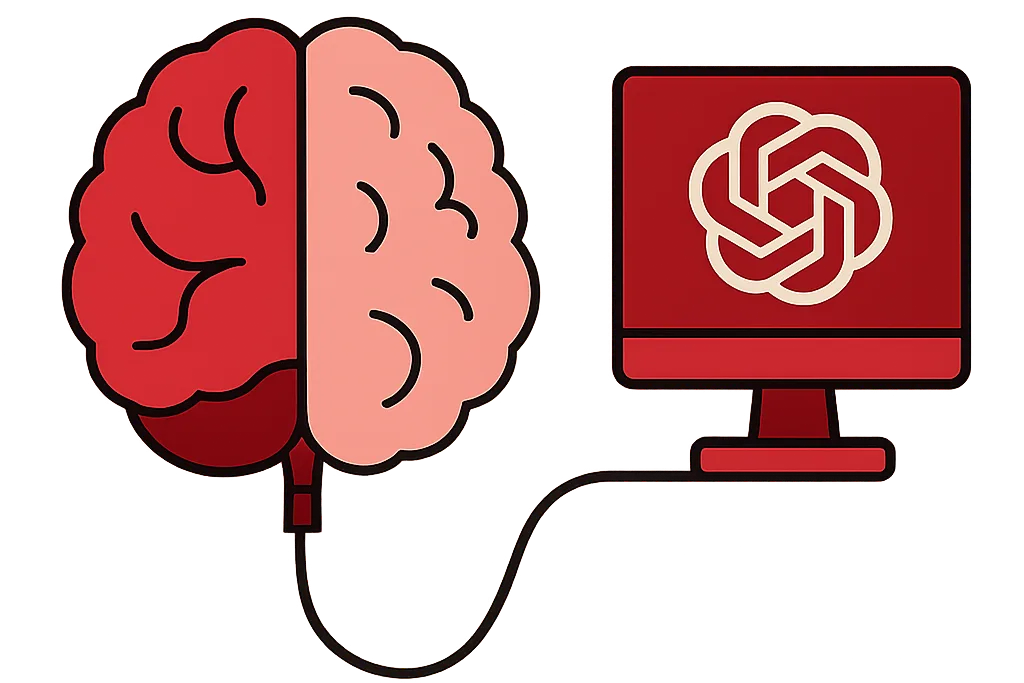
Artificial intelligence is creeping into classrooms quietly, but persistently. Whether it’s welcomed or quietly banned, students are using it — sometimes openly, sometimes not. Maybe you’ve marked an essay that was grammatically flawless, but somehow felt “soulless.” Or thought there’s no way your student wrote that report on their own. Maybe ChatGPT wrote it.
A recently published study by MIT researchers carries a telling title: Your Brain on ChatGPT. It looked at how using AI affects writing, learning, and brain activity.
How was the study run?
- 48 university students completed four writing tasks over the course of several months.
- One group wrote unassisted, another had internet access, and a third used ChatGPT.
- Researchers tracked their brain activity with EEG, along with their language skills, the quality of their writing, and their ability to remember what they’d written themselves.
And what did they find?
- Those who wrote with ChatGPT’s help showed significantly lower brain activity.
- After a few months, they remembered less of what they’d written — often unable to recognise their own text.
- Researchers described this as cognitive debt — the brain “unlearns” how to think when AI does the work instead.
- Those who wrote unassisted first and only used AI later did better across the board.
A word of caution — this is a preliminary study
This study hasn’t yet gone through peer review. That means the scientific community hasn’t yet examined and confirmed it as a final conclusion.
Scientific knowledge builds up gradually. There’s no such thing as an unambiguous “overnight discovery.” This paper is a preprint — an early version of a study shared openly so others can examine, criticise, confirm, or refute it.
That, incidentally, is a lovely example for teaching scientific literacy:
- Not every article is true.
- Results need to be verified.
- And even “big headlines” need context.
It’s not black and white: this isn’t about banning AI
The study doesn’t say ChatGPT is harmful. It just says that how you use it matters.
If we let AI do all the work for us, our brain really does engage less. But if we use it as a tool for supplementing, inspiring, or revising our own work, it can help us learn more, and better.
It’s a bit like a calculator:
- If I use it while learning the basics of multiplication, I don’t learn anything.
- But if I only use it once I’m tackling more complex problems, it saves time and helps me focus on actually understanding things.
So how do you work with this in the classroom?
Since we often train teachers in media and information literacy too, this question comes up naturally. A few quick tips:
- Set tasks that can’t be outsourced to AI — personal experience, reflection, drawing, working through a mistake: AI can’t (yet) do any of that.
- Have students write without AI first, and only then let them compare their own output against AI’s. Discuss the differences.
- Introduce an “AI reflection” — What did students ask for? What did they get back from AI? What was useful? What was silly? Did they learn anything from it?
- Try a “Me vs. ChatGPT” role-play — Have a student argue against AI’s answer. It helps build critical thinking, which matters not just for working with AI, but sits at the core of media and information literacy generally.
- Add a lesson on how science actually works — using this very study as an example, say. It’s a great opportunity to tie AI, writing, science, and critical thinking together into one package.
And if you’d like to dig into this topic further, get in touch — we’re happy to put together a workshop tailored to you.
What to take away from this
Artificial intelligence is changing the world, and teaching has to change along with it. But if we approach AI critically, deliberately, and with some perspective, it can be more than just a helper — it can be a gateway to a deeper understanding of the world. The brain is like a muscle — and artificial intelligence should be a dumbbell, not a crutch.